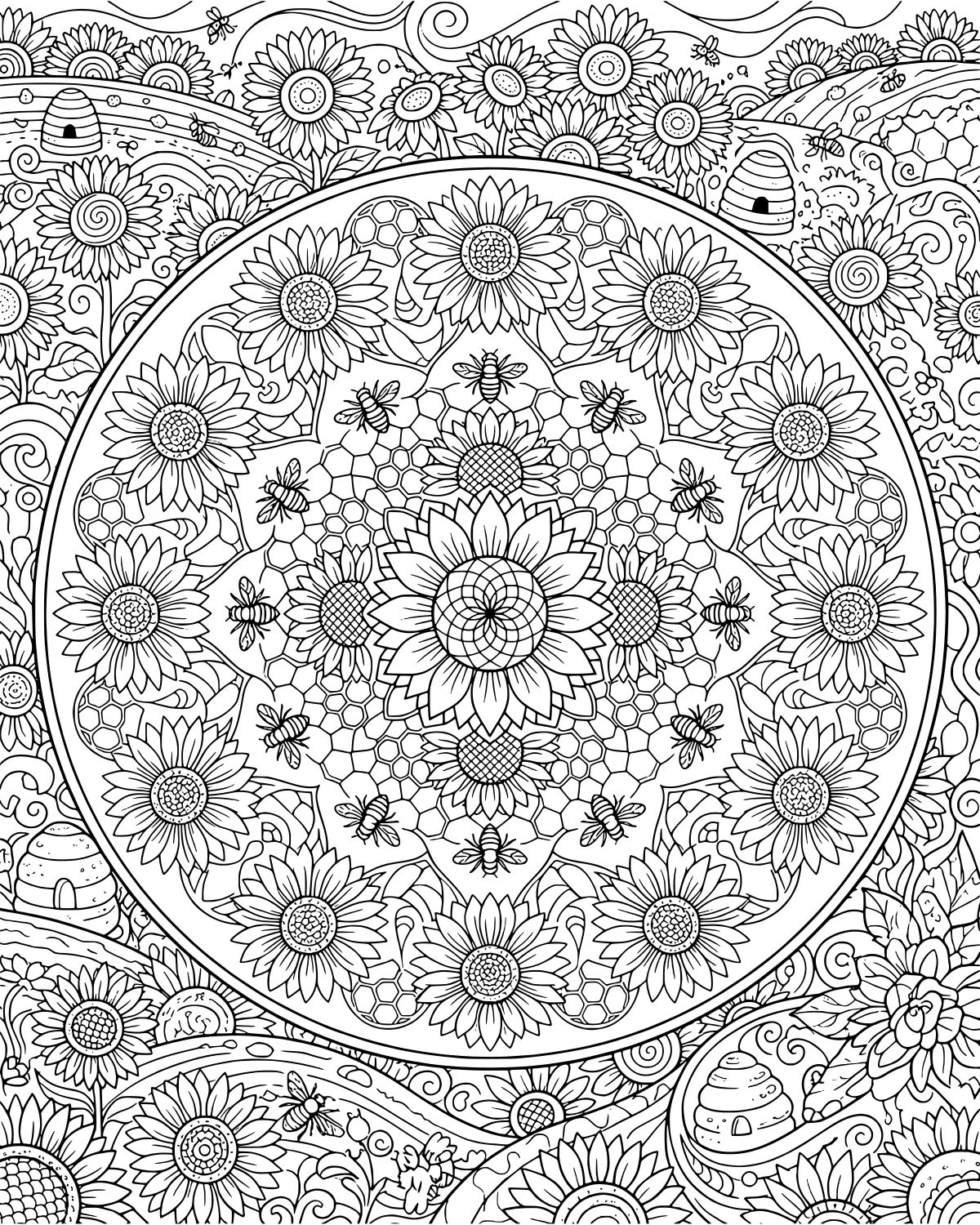
This sunflower mandala brings together the beauty of a summer garden and the busy life of honeybees. You can almost hear the gentle hum of wings as they fly between the honeycomb patterns and the bright flower petals. It is a wonderful way to spend a quiet afternoon focusing on the intricate details of nature. The balance of the circular design makes it a peaceful project for anyone who loves the outdoors and the harmony of the natural world.
Every part of this scene is filled with life and movement. From the central sunflowers to the tiny bees navigating the swirls, there is so much to explore. This page celebrates the hard work of pollinators and the simple joy of a blooming garden under the sun.
Color Palette Ideas
What's In This Picture
In the center of the page, a large sunflower serves as the heart of the mandala, surrounded by perfectly shaped honeycomb cells. Busy bees are scattered throughout the design, some landing on the petals while others hover near the swirls and delicate leaves. The symmetry of the flowers and patterns creates a sense of calm and order.
In the background, you will find rolling hills that stretch toward the horizon, dotted with traditional beehives where the colony lives and works. Smaller flowers fill the gaps between the main subjects, creating a dense and rewarding scene. The variety of textures, from the smooth curves of the swirls to the geometric lines of the honeycomb pattern, provides plenty of opportunities for creative expression.
Coloring Tips
Because the lines are quite dense, using fine-tipped markers or sharpened colored pencils will help you stay within the small spaces of the honeycomb pattern. You might want to use different shades of yellow and orange for the sunflowers to give them depth and a sun-kissed look. Blending a bit of brown or deep red into the center of the flowers can make them look very realistic.
For the bees, a bright gold paired with a dark chocolate brown creates a natural contrast. You can also experiment with gradients on the rolling hills, using lighter greens for the distant slopes and richer, darker tones for the foreground. If you want the swirls to stand out, try using a metallic gel pen or a very light blue to give them a breezy, airy feeling.
Did You Know?
Did you know that bees communicate with each other through a special movement called the waggle dance? This helps them tell their hive mates exactly where to find the best patches of sunflowers and other flowers. A single bee can visit thousands of flowers in just one day to collect nectar for their colony, making them some of the hardest workers in the animal kingdom.
Try This!
After finishing your masterpiece, try to count all the bees hidden within the patterns or see if you can identify every honeycomb cell. You could even draw your own tiny garden scene on the back of the page using the same swirling shapes and natural elements found here. Another fun idea is to research different types of sunflowers to see which colors you want to use next time.
Frequently Asked Questions
What is the best way to color the tiny honeycomb cells?
Can I use watercolors on this coloring page?
How many bees are hidden in this mandala?
Popular Collections

Animal Coloring Pages
Animals bring a special kind of life to any art project. Whether you love the quiet of a deep forest...
Cute Coloring Pages
Finding something charming and sweet to color is one of the quickest ways to brighten a rainy aftern...

Kawaii Coloring Pages
Kawaii is more than just a word for cute; it is a whole aesthetic that celebrates the joy in the sma...

Funny Coloring Pages
Laughter is a wonderful part of childhood, and our collection of Funny Coloring Pages is designed to...
You Might Also Like

Ornate Heart Padlock and Antique Key
Mandalas & Patterns
Intricate Butterfly Mandala Design
Mandalas & Patterns
Regal Crowns and Jewels Mandala
Mandalas & Patterns
Majestic Mandala Lion Face
Mandalas & Patterns
Intricate Ornamental Horse Portrait
Mandalas & Patterns
Tropical Ocean Mandala with Sun and Starfish
Mandalas & Patterns
Intricate Geometric Petal Mandala
Mandalas & Patterns
Intricate Sun Center Geometric Mandala
Mandalas & Patterns